
The Definitive Baby Proofing Evidence Review: What Science Says Works (and What Doesn't)

Most parents spend more time researching strollers than they do thinking about what injures children. That’s not a criticism. It’s a pattern the injury data shows clearly, and it’s one worth correcting before you buy your fourth outlet cover and still haven’t anchored the dresser.
This is a review of the evidence. What works, what doesn’t, and where the research is more definitive than most parenting content lets on.
Falls: The Numbers Demand Physical Barriers
Falls are the leading cause of nonfatal injury for children under 5, and the stair data alone is striking. About 93,000 children under 5 are treated in U.S. emergency rooms each year for stair-related injuries, according to a Nationwide Children’s Hospital analysis of CPSC NEISS data covering 1999–2008. That’s roughly one child every six minutes.
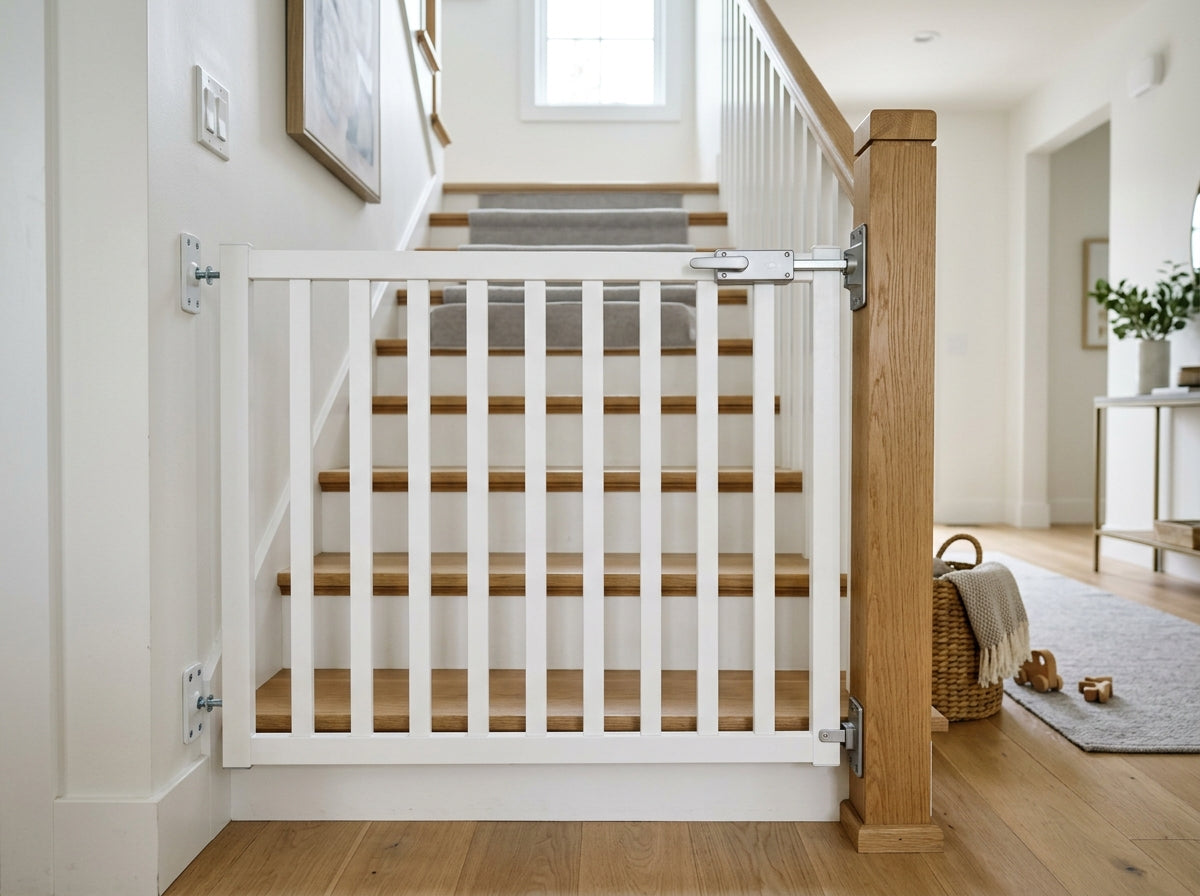
Physical barriers at the top and bottom of stairs reduce fall risk more reliably than supervision alone. Hardware-mounted gates, not pressure-mounted ones, belong at the top of stairs. A pressure-mounted gate can be pushed out by a falling child’s weight, which is why the distinction matters. Hardware-mounted gates meet ASTM F1004 standards and are required under 16 CFR Part 1239 (effective 2021).
Window guards follow the same logic. A window screen provides no fall protection. A properly installed guard or stop that limits opening to 4 inches does. Parents often assume screens are a barrier. They are not.
In my experience, a pressure-mounted gate at the top of stairs is not reliable. My older daughter walked directly into one with enough force that I was grateful I’d already replaced it with a hardware-mounted model.
Drowning: The Evidence for Pool Fencing Is Definitive
Per the CDC, more children ages 1–4 die from drowning than from any other cause of death. And CDC MMWR Vital Signs Drowning death rates among children aged 1–4 years rose significantly in 2021 (28.9%) and 2022 (28.3%) compared with 2019. This is not a stable problem. It is getting worse.
The intervention with the strongest evidence is four-sided isolation fencing around pools. Not three-sided fencing that uses the house as one wall. Four-sided. The research consistently shows this design reduces drowning risk more than any other single intervention, including flotation devices, swimming lessons, or CPR training. Those other layers matter, but none of them replaces the fence.
The AAP states that a child can drown in as little as one to two inches of water. Buckets, bathtubs, and decorative fountains all qualify. This is why the fencing evidence applies specifically to pools, but the supervision principle extends to any standing water in or around the home. Empty buckets after use. Close bathroom doors. Don’t rely on a child’s ability to self-rescue.
Flotation devices are not a substitute for barriers. This is one of the clearest misalignments between parental perception and actual risk reduction. A child wearing floaties in an unsupervised pool is not protected. A child who cannot reach the pool because of a locked, four-sided fence is.
Sleep Safety: The Bare Crib Standard Holds
About 3,500 infants die each year from sleep-related causes in the United States, per CDC SUID data. Unintentional suffocation kills roughly 1,000 infants under age 1 each year in the United States (CDC). These are not the same deaths, but they overlap, and the intervention evidence points in one direction: the bare crib.
Current CPSC and AAP guidance supports removing bumpers, pillows, blankets, positioners, and soft objects from the sleep environment for infants under 12 months. The crib standards have improved significantly. Older drop-side cribs were banned by CPSC in 2011. Modern cribs meeting current ASTM standards have eliminated many of the structural hazards that caused deaths in prior decades.
But the soft bedding problem persists because it’s driven by marketing, not safety data. Crib bumpers were sold for decades as protective. The evidence now shows they pose suffocation and entrapment risks. The Safe Sleep for Babies Act of 2022 banned their sale nationwide, and the AAP recommends against them. And yet they still turn up secondhand and from overseas sellers.
The safest sleep surface is firm, flat, and bare. Infant on their back. Nothing else in the crib. This is not a guideline that requires nuance or product testing. It is the most evidence-supported sleep recommendation available.


Poisoning: Locks Beat Labels
Child-resistant packaging is a meaningful intervention. It has reduced pediatric poisoning deaths since the Poison Prevention Packaging Act was passed in 1970. But it is not sufficient on its own, and parents who rely on it are working with an incomplete picture.
Packaging can be left open. It can fail. And some children defeat it faster than adults expect. CPSC recalled 900,000 Safety 1st Push 'N Snap cabinet locks in March 2012 after 140 children defeated them, and three reached toxic cleaning products including dishwashing detergent, window cleaner, and oven cleaner.
In my experience, adhesive locks fail quickly. My younger daughter emptied an under-sink cabinet at 14 months by pulling an adhesive strap lock until it gave. I’d moved toxic items to high storage after my older daughter defeated a similar lock at 26 months. The combination of locked cabinets plus high shelving for the most dangerous items is more reliable than either approach alone.
Medications deserve separate attention. Many pediatric poisoning emergencies involve prescription medications left on counters or in purses. Locked storage is the standard. Grandparent visits are a documented risk factor because guests often carry medications in bags that aren’t locked.
Furniture Tip-Overs: Anchoring Is Not Optional
Furniture tip-over injuries have increased in recent years, and the pattern is consistent: a toddler climbs a dresser drawer, a bookcase, or a TV stand, and the piece falls forward. Entrapment and crushing injuries are the result. Deaths occur.
Anchoring heavy furniture to wall studs is the intervention. Anti-tip straps are inexpensive and widely available. The installation takes about 20 minutes per piece. The evidence that it prevents injuries is not complicated. A piece of furniture that cannot tip over cannot crush a child.
This is especially important in toddler rooms because climbing is developmentally normal behavior, not a parenting failure. A 2-year-old climbing dresser drawers is doing exactly what 2-year-olds do. The dresser needs to be anchored because the behavior cannot be reliably prevented.
Televisions on furniture rather than wall-mounted are a specific risk. A large TV on an unstable stand adds top-heavy weight that increases tip-over likelihood. Wall-mounting the TV, or anchoring the stand to the wall, addresses this. The strap needs to be rated for at least several times the weight of the TV and furniture combined to provide a meaningful safety margin.
Choking: Age-Specific Guidance Matters More Than Labels
Generic "choking hazard" labels are applied to products with objects smaller than 1.25 inches in diameter, which is the standard for children under 3. But the risk picture doesn’t end at age 3. Hard candies, nuts, grapes, hot dogs, and raw carrots remain choking risks through age 5 because of how children chew and swallow at different developmental stages.
Parents need age-specific guidance, not a single warning label. For children under 12 months, any object that fits through a toilet paper tube is a risk. For children 12–36 months, the same size rule applies, but the category of hazardous foods expands as children eat more table food. For children 3–5 years, the object-size risk decreases, but certain food textures and shapes remain dangerous.
Cutting grapes and hot dogs lengthwise, not just in rounds, is the recommendation because rounds can form a seal over the airway. This is a specific, evidence-based modification that takes about five extra seconds and meaningfully reduces risk.
Electrical Safety: Built-In Beats Plug-In
Plug-in outlet covers reduce access to unprotected outlets. They are better than nothing. But they can be removed by children, left out after use, and create a choking hazard if a child pulls one free and mouths it.
Tamper-resistant receptacles (TRRs) are built into modern construction codes and require simultaneous pressure on both slots to allow insertion. A child pressing a single object into one slot cannot complete the circuit. The NEC has required TRRs in new residential construction since 2008.
If your home was built or renovated after 2008, you likely already have them. If not, upgrading outlets is a more reliable long-term solution than maintaining a supply of plug-in covers. An electrician can replace standard outlets with TRRs. The cost per outlet is low. The reliability advantage over plug-in covers is real.
Window Blind Cords: Eliminate, Don’t Manage
Blind cords cause strangulation deaths in young children. A looped or accessible cord near a crib, bed, or play area can wrap around a child’s neck. CPSC guidance recommends eliminating accessible cords entirely.
Cord wraps, tie-ups, and wind-up devices reduce risk compared to loose cords. But they require consistent use, and the evidence for consistent use in real households is not strong. Parents forget. Babysitters don’t know the protocol. The cord gets pulled loose.
Cordless blinds and shades are the reliable solution. Motorized options exist for larger windows. For any window near a sleep area or where a child could access a cord, replacement is the appropriate intervention. This is one of the clearest cases where the "management" approach is weaker than the "eliminate the hazard" approach.
Baby Walkers: The Evidence Against Them Is Clear
Baby walkers do not accelerate motor development. This finding has been replicated. The AAP has recommended against their use for years, and Canada banned their sale in 2004.
The injury mechanism is mobility. A walker allows a child to move faster than they could independently, reach surfaces and objects they couldn’t otherwise access, and approach stairs before they have the balance or judgment to stop. Falls down stairs in walkers are a documented cause of serious injury.
Stationary activity centers provide similar sensory and play stimulation without the mobility risk. They keep a child in one place, engaged, and safe from the hazards a walker would bring them toward. The developmental benefit argument for walkers has not held up. The injury risk argument against them has.
Home Safety Action Checklist
Secondhand Equipment: Verify Before You Use
Hand-me-down cribs, car seats, and high chairs are common, and many are fine. But some are not, and the risk is not always visible.
Older cribs may predate the 2011 ban on drop-side designs. A crib manufactured before that ban may have a structural design that was linked to infant deaths. The manufacture date matters. If you cannot verify it, the crib should not be used.
Car seats have expiration dates, typically 6–10 years from manufacture, because plastic degrades and safety standards change. A seat that was safe in 2010 may not meet current standards and may have structural fatigue that isn’t visible. NHTSA lists car seat recalls at nhtsa.gov/recalls, and the CPSC database covers most other baby gear. Checking a specific model number before use takes about two minutes and is worth doing for any secondhand safety equipment.
High chairs, bouncers, and swings have also been subject to recalls. The CPSC recall database is searchable by product type and model. This is not a theoretical concern. Recalls happen because products fail, and secondhand items may have been recalled without the current owner knowing.
Supervision and Layered Protection
Supervision is necessary. It is not sufficient. This is one of the most important findings in pediatric injury prevention research, and it runs counter to how many parents think about safety.
Even attentive caregivers cannot prevent all injuries. Falls happen in the time it takes to answer a phone. Drowning can occur in under two minutes in complete silence. Poisoning happens when a parent is in the next room. The research on supervision consistently shows that it reduces risk but does not eliminate it, particularly for falls and drowning.
Effective injury prevention combines physical barriers, product standards, and active monitoring. Each layer addresses a different failure mode. A safety gate works when you’re not watching. A locked cabinet works when you’re distracted. A four-sided pool fence works when a child wanders out a door you didn’t hear open. No single layer is enough. All of them together create a margin that supervision alone cannot provide.
Where Parental Perception Misses the Mark
Parents consistently overestimate stranger danger and underestimate falls, poisoning, and drowning. This is well-documented in injury prevention literature, and it has real consequences for how families allocate their attention and resources.
The risks that cause the most pediatric injuries and deaths are ordinary household hazards. Stairs. Pools. Cleaning products. Furniture. These are not dramatic scenarios. They are the environments children live in every day, which is precisely why the data looks the way it does.
Evidence-based baby proofing starts with the leading causes of injury, not the most frightening-sounding ones. Gates at stairs. Four-sided pool fencing. Locked cabinets. Anchored furniture. Cordless blinds. A bare crib. These interventions address the hazards that are most likely to harm your child. They are also, with a few exceptions, affordable and achievable in a weekend.
The goal is not a perfectly childproofed home. It is a home where the most dangerous hazards have been addressed with the most effective interventions available, and where supervision fills the gaps that physical barriers cannot. That combination is what the evidence supports.