
Changing Table Height: Standard Heights, Using a Dresser, and What Works for Tall or Short Parents
There’s no one right changing table height: aim for about elbow height with the pad on, anchor any dresser you use and keep a hand on your baby.

The AAP’s changing-table checklist gives no height figure. None of the major requirements CPSC staff list for the federal safety standard for baby changing products (ASTM F2388) sets a height for the changing surface. So changing table height comes down to the person doing the changes. Aim for about elbow height, judged with the pad in place, which is the yardstick NIOSH, the CDC’s workplace safety institute, uses for work in general.
If you are setting up a safe nursery, you can settle this with a quick check at the furniture itself. A purpose-built table, a dresser with a pad on top and an add-on unit all get judged the same way: by how your body sits at the surface.
Changing Table Height Starts at Your Elbow
NIOSH says most work should be performed at about elbow height. It also says a work table at the wrong height may cause unnecessary stress to the back, shoulders and neck. That is general ergonomics for work, not a baby-care rule.
At a changing table, the work happens on your baby lying on the pad. So judge the height with the pad in place, not by the bare furniture top. A pad adds to the surface, and the surface is where your hands end up.
The AAP’s checklist asks for a sturdy, stable changing table with a 2-inch (5-cm) guardrail around all four sides. Those are the features to look for first. After that, the right height is the one that fits the person doing the changes.
The Elbow Check, Step by Step
Do this at the furniture before your baby is on it. Once your baby is on the pad, one hand stays on your baby.
-
Put the pad in place
Set it on the surface exactly as you will use it. -
Relax your shoulders
Stand at the surface with your upper arms hanging at your sides. -
Bend your elbows to about a right angle
NIOSH calls this the neutral elbow posture, a 90-degree bend. -
Notice where your hands land
Hands meeting where your baby lies means the height is close. Bending forward at the waist means too low. -
Check your arms
If you lift your arms away from your sides, the surface is too high. NIOSH says raising the arm increases shoulder muscle activity.
Match what you notice at the surface to the fix:
| Result | What you notice | What NIOSH says | What to change |
|---|---|---|---|
| Too low | Bend forward at the waist | Awkward posture, per NIOSH | Choose taller furniture |
| About right | Hands reach, arms at sides | Most work at elbow height | Keep height, hand on baby |
| Too high | Arms lift away from sides | Raised arm increases shoulder activity | Choose a lower surface |
Dimensions and Fit: Barriers, Warnings and Furniture Size
The dimensions that do matter are about barriers and fit. The federal standard requires barriers on all baby changing products. The AAP recommends a 2-inch (5 cm) guardrail on all four sides of any changing table.
Fit is where the pad’s paperwork helps. The federal standard requires a warning on contoured changing pads and add-on changing units sold separately and designed to be attached to furniture. The warning either identifies the specific furniture to use or says the support surface should be level, stable and structurally sound. In the second case, the maker fills in minimum surface dimensions.
Read that warning before you buy furniture. When it lists minimum dimensions, those numbers, not a “standard” size, tell you whether a dresser top is big enough. When it names specific furniture, that is the furniture to use.
Choosing among contoured, flat and portable changing pads is a separate question from height.


Changing Table Height on a Dresser
A dresser can be the changing station, with one catch. The federal standard’s definition says a changing table may convert from or to other furniture, such as a dresser. But CPSC staff explain that a dresser that only becomes a changing table when a changing tray or contoured changing pad is added does not fall within the scope of the federal rule for baby changing products.
For the stability of dressers that incorporate changing products, CPSC staff point to a separate standard for clothing storage units. So the dresser’s own steadiness is yours to check and secure.
Height works the same way. The pad sits on top of the dresser, so a dresser’s listed height is not your changing surface height. Run the elbow check with the pad on.
Think through your nursery furniture layout before you commit. The dresser you use for changes needs a wall behind it to anchor to. It also needs open floor in front, so you can stand close.
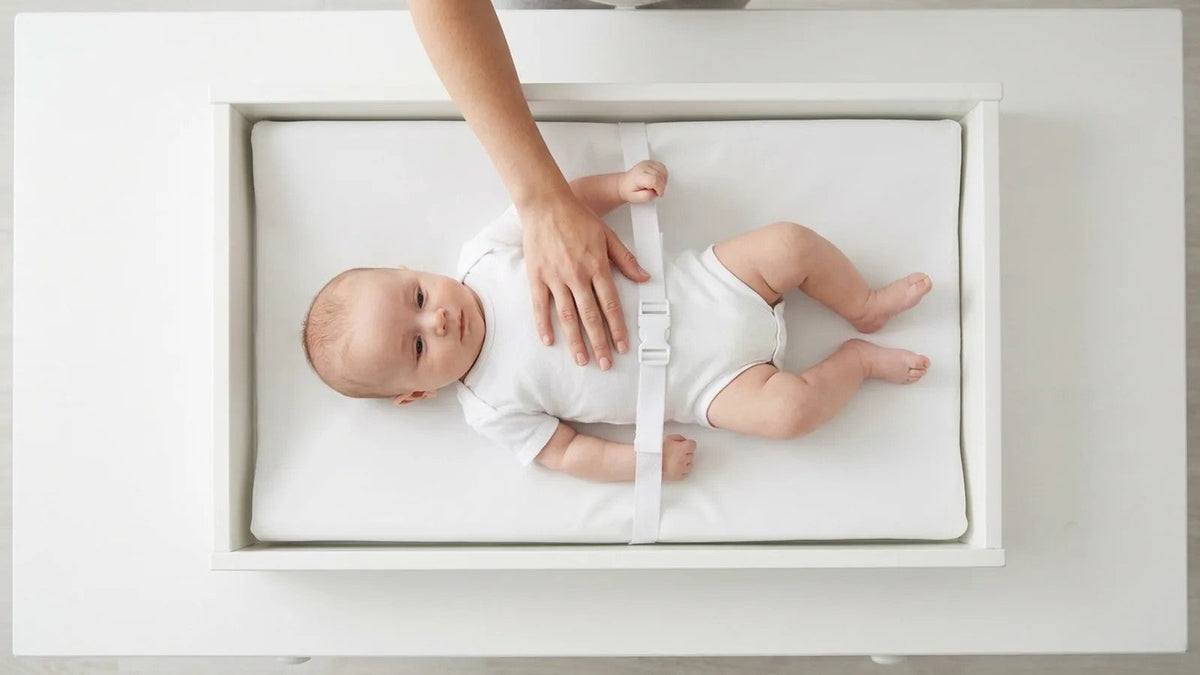
For a dresser-top station, the Nest Eva Diaper Changing Pad has raised sidewalls, a non-slip base and an adjustable safety belt. Its waterproof EVA foam surface wipes clean, with no cover or liner. The product page warns that it is not a substitute for adult supervision and says to stop using it immediately if it becomes faulty. The belt is a backup to your hand, never a replacement.

Anchor the Furniture Before It Becomes a Station
Before the first change, the job is anchoring the dresser to the wall with a tip-over restraint device. Follow the instructions that come with the hardware.
In CPSC’s 2023 tip-over report, chests, bureaus and dressers were involved in 36% of reported tip-over deaths (79 of 217) from January 1, 2013 through July 31, 2023. Of those 79 deaths, 64 (81%) involved a child. CPSC counts anyone younger than 18 as a child.
The same report lists these among the things that can make furniture unstable:
- Not using a tip-over restraint device
- Heavy objects on top of furniture
- Multiple open drawers
- Use on a sloped or unstable surface such as carpet
A changing routine touches several of these. Open only the drawer you need, then close it again, since CPSC lists multiple open drawers among the causes of instability. Keep heavy objects off the top.
And as the AAP advises, keep diapering supplies within your reach but out of your baby’s reach. That way you never have to leave your baby’s side to get them. Anchoring lowers the tip-over risk. It does not replace watching your baby.
Changing Table Height for Tall People
Picture this: you are tall, the dresser is low, and every change starts with a forward bend over the pad, one hand on your baby. NIOSH lists bending the torso forward among awkward postures, and a low surface asks for that posture every time.
The fix is a taller changing surface chosen with the elbow check, not a stack. A taller piece of furniture brings your hands closer to the elbow height NIOSH describes for most work.
Never raise the pad on books, boxes, a second pad or cushions. The federal pad warning described above either names the specific furniture to use or calls for a support surface that is level, stable and structurally sound. A stack is neither.
If two caregivers share the station, run the elbow check for both of you before choosing the furniture.
What Works for Shorter Parents
Now flip the problem. The surface is high enough that you raise your arms to reach your baby, and you lift your baby in and out at arm’s length. In NIOSH’s demonstrations, shoulder muscle activity rises as the arm is raised.
Lifting adds a second issue. NIOSH’s lifting principle is to keep loads close to the body. Even light objects can cause large forces in the lower back, NIOSH says, if they are lifted or carried farther away from the body.
Choose a lower surface with the elbow check. Stand close to the furniture. Hold your baby close to your body as you lift in and out. If your back, shoulders or neck bother you, talk to your doctor.
Safety Habits That Stay the Same at Any Height
Height is one piece of diaper changing safety, and the habits below apply whatever surface you choose. The AAP notes that although a changing table makes it easier to dress and diaper your baby, falls from such a high surface can be serious.
The AAP says to buckle the safety strap but not to depend on it alone, and to always keep a hand on your baby. It also says never to leave a child unattended on the table, even for a moment, even if strapped.
The fall warning the federal standard requires on changing products says falls can happen quickly and to stay within arm’s reach. In practice, your hand stays on your baby for the whole change.