
Baby Proofing for 0-3 Months: Newborn Safety Essentials

The first weeks with a newborn feel like survival mode. You’re running on broken sleep, learning your baby’s cues, and trying to remember the last time you ate a real meal. Baby proofing probably feels like a problem for future-you, the one who has a mobile, curious crawler to chase around. But a few of the most critical safety steps belong in these early weeks, not because your newborn is getting into things, but because the habits you set now are harder to build later, and some hazards don’t wait.
Your newborn spends almost all of their time in three places: a sleep surface, a car seat, and your arms. That’s where you start.
Safe Sleep Is the First Priority
According to CDC SUID data, about 3,500 infants die each year from sleep-related causes in the United States. Unintentional suffocation kills roughly 1,000 infants under age 1 each year, per the CDC. Those numbers are sobering, and they’re also almost entirely preventable with the right setup.
The rules are simple and they don’t bend. Place your baby on their back for every sleep, every time. Use a firm, flat surface, specifically a crib, bassinet, or play yard that meets current CPSC standards. No soft bedding, no pillows, no bumpers, no positioners. CPSC standards require crib slats to be no more than 2 3/8 inches apart (about the width of a soda can), and the mattress should fit so snugly that you cannot fit more than two fingers between it and the crib side. Check your equipment weekly, and retire anything with broken hardware, missing parts, or structural damage.
I know the pull toward co-sleeping. I felt it too, especially at 3 a.m. when my older daughter would only settle against my chest. But the sleep surface matters more than convenience. A crib or bassinet that meets current standards is the only safe option for unsupervised sleep.
Keep the sleep area clear of cords. Blind cords, curtain pulls, monitor cables, and phone chargers should all be routed at least 3 feet from the crib. Cords pose a strangulation hazard and apply to every piece of equipment near the sleep space, including video monitors with long cables. Clip or bundle excess cord behind furniture, not just out of reach of your current newborn, but out of reach of the toddler your baby will become.


Room Temperature and Overheating
Overheating is associated with increased SIDS risk, and it’s one of the easier variables to control. Dress your baby in one more layer than you’d wear comfortably, and skip the extra blankets. A wearable sleep sack is a better choice than any loose covering.
Monitor your room temperature, especially in summer. A room that feels comfortable to you may be too warm for a swaddled infant. If you’re sweating, your baby almost certainly is too. There’s no magic number for room temperature, but most sleep guidance points to 68°F–72°F (20°C–22°C) as a reasonable range.
Your Car Seat Installation Needs Professional Eyes
Your car seat is one of the most safety-critical pieces of equipment you own, and most parents install it incorrectly on the first try. The angles, the belt routing, the recline indicator, the chest clip height, the harness tension: there are a lot of variables, and a small error in any one of them reduces protection in a crash.
Have your installation inspected at a certified car seat inspection station or by a NHTSA-certified technician before your baby comes home from the hospital. Many fire stations, hospitals, and pediatric clinics offer this service free of charge. Even if you’ve read every instruction twice, a second set of trained eyes is worth the hour.
When I had my younger daughter’s infant seat checked, the technician found the recline angle was slightly off and the harness was routed through the wrong slot. Both were easy fixes. Neither was obvious to me.
Smoke and Carbon Monoxide Detectors
Per NFPA data, three out of five home fire deaths occur in homes with no smoke alarms or non-functioning ones. Per the CDC, CO poisoning kills more than 400 people each year and sends more than 100,000 to U.S. emergency rooms. These are two of the most effective injury-prevention tools available, and they require almost no ongoing effort once installed correctly.
Install smoke detectors on every level of your home, inside every bedroom, and outside each sleeping area. Install carbon monoxide detectors on every level as well, and within 10 feet of bedroom doors. Test both monthly. Replace batteries annually, or choose detectors with sealed 10-year batteries. Most detectors have a lifespan of 7–10 years. Check the manufacture date on the back of yours.
This is not a step to defer. If your detectors are overdue for replacement or missing from any level of your home, do it this week.
Water Temperature and Scald Prevention
According to a 2025 Journal of Burn Care & Research analysis of NEISS data (2013–2022), approximately 125,000 scald burns occur nationally among children ages 0–3 each year, with 81% occurring at home. Your water heater is one of the most direct contributors to that risk.
The AAP recommends setting your water heater to 120°F (49°C) or lower. At 120°F, serious burns require several minutes of exposure. At 140°F (60°C), serious burns can occur in under five seconds. Set it once and you don’t have to think about it again. Most water heaters ship from the factory set higher than 120°F, so check yours.
This matters for newborns during sponge baths and diaper changes, and it matters more as your baby grows and bath time becomes a daily routine.
Furniture Tip-Overs and the Changing Table
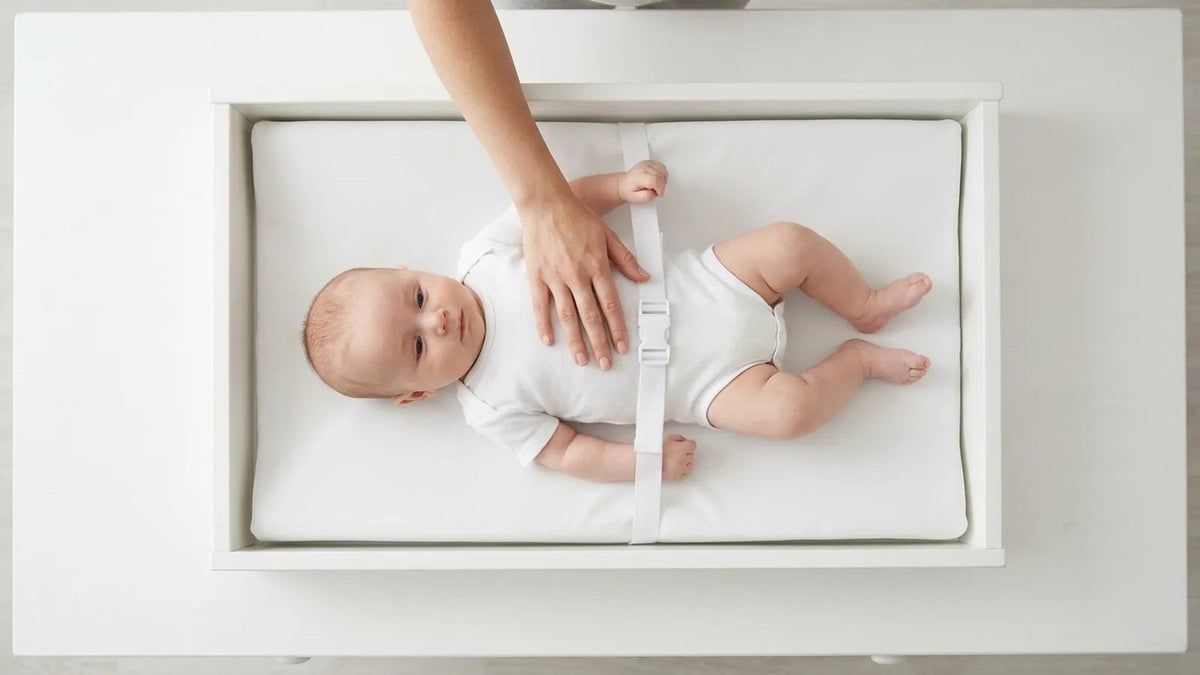
Falls from changing tables are a leading cause of head injuries in infants. The height of a changing table combined with the brief moments of distraction during a diaper change creates real risk. Strap your changing table or dresser to the wall with anti-tip hardware before your baby comes home.
This step is often skipped because the hazard doesn’t feel immediate. But the scenario that matters isn’t your newborn rolling off. It’s an older sibling who climbs, a bump from a laundry basket, or a moment when you turn to grab a wipe. Anti-tip straps are inexpensive, take about 20 minutes to install, and eliminate a category of risk entirely.
While you’re at it, anchor any other tall furniture in your home: bookshelves, dressers, media consoles. Your baby is not mobile now. But by the time they are, you want these habits already in place.
Medications, Cleaning Products, and Poison Prevention
Per America’s Poison Centers, someone in the U.S. calls a poison center about an exposure every 15 seconds, approximately 2.1 million calls in 2024. Your newborn cannot reach the under-sink cabinet. But your newborn will be a curious crawler in roughly six months, and the habits you establish now determine whether that cabinet is safe when they get there.
Lock or latch every cabinet that contains medications, supplements, vitamins, cleaning products, or anything else you wouldn’t want a child to ingest. Keep medications in their original child-resistant containers and store them high, not just in a low cabinet with a latch. Child-resistant packaging is not childproof. The CPSC recalled 900,000 Safety 1st Push 'N Snap cabinet locks in March 2012 after 140 children defeated them, and three reached toxic cleaning products. Height and locked storage together are more reliable than any single barrier.
This also protects visitors’ children and any older siblings who may be curious about what’s under the sink.
Baby Gates: Install Them Before You Need Them
Per the CDC, falls are the most common cause of nonfatal injuries for children ages 0 to 19. According to a Nationwide Children’s analysis of CPSC NEISS data (1999–2008), about 93,000 children under 5 are treated in U.S. emergency rooms each year for stair-related injuries.
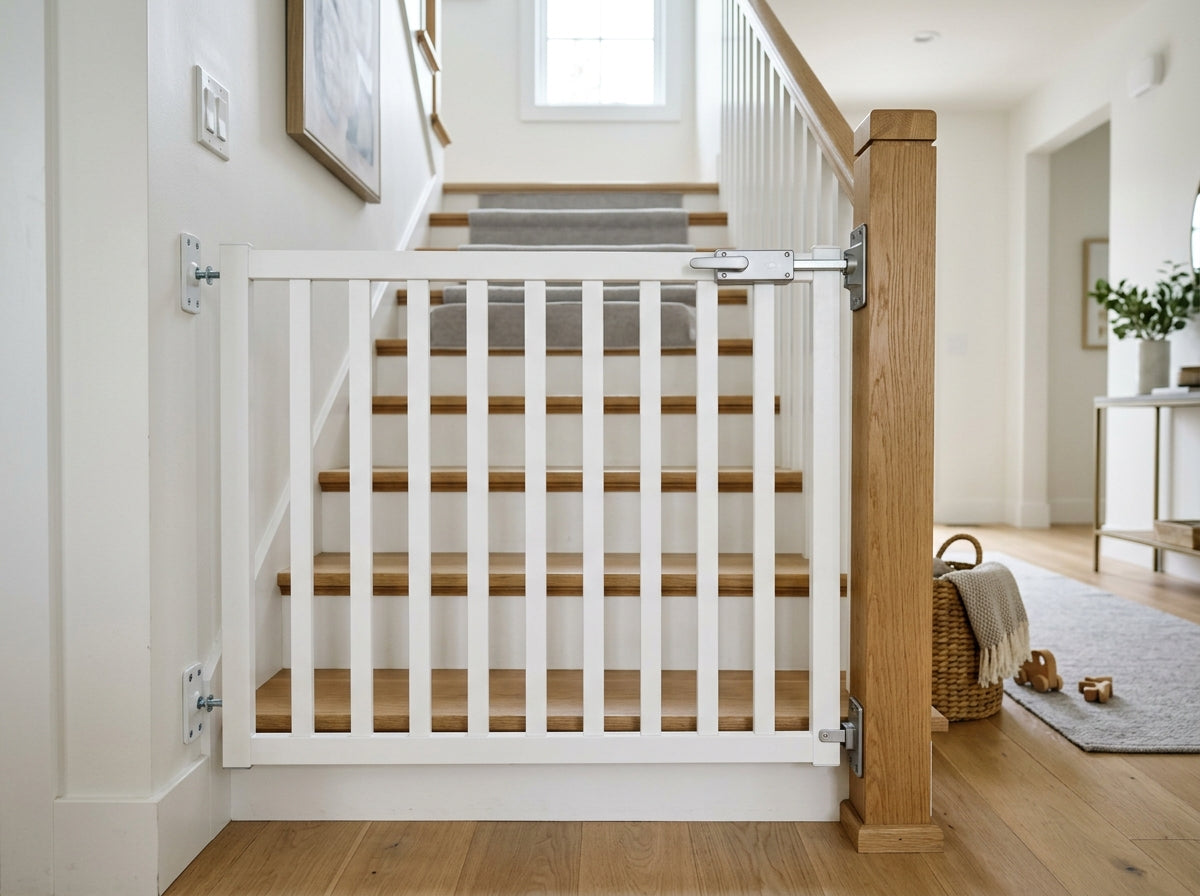
Your newborn is weeks away from being able to roll, and months away from mobility. But installing gates at the top and bottom of every staircase now means the habit is built before the risk arrives. A gate installed under pressure, the week your baby starts pulling up, is more likely to be installed wrong.
For stair gates, use hardware-mounted gates only. Pressure-mounted gates are not rated for the top of stairs. Look for gates that meet ASTM F1004, the federal safety standard for expansion gates and expandable enclosures (mandatory under 16 CFR Part 1239 as of 2021).
Newborn Safety Checklist
Pets and Newborns
Even a gentle, well-trained pet can accidentally smother or injure a newborn. Dogs may jump up to investigate. Cats may seek warmth near a sleeping baby. The risk is not malice. It’s size, weight, and the fact that your newborn cannot move away.
Establish a clear rule before your baby comes home: no unsupervised contact between pets and baby. Keep pets out of the room where your baby sleeps with a closed door or a gate. Do not use crib tents or crib covers: the CPSC has warned crib tents can trap and strangle babies. Supervise every interaction, and don’t rely on a pet’s past behavior as a guarantee of future behavior around a newborn. Start this boundary early, and it becomes the household norm before your baby is old enough to be on the floor where pets roam freely.
What You’re Building Right Now
None of these steps require a full home overhaul. You’re not childproofing every cabinet and outlet this week. You’re securing the specific environments your newborn occupies, and building the habits that will carry you through the next two years of rapid developmental change.
According to CDC developmental milestones, most babies roll from tummy to back by 6 months. By 1 year, most children pull up to stand and walk while holding onto furniture. The window between now and then is shorter than it feels at 3 a.m. with a newborn on your chest. The steps above are the ones worth doing before that window closes.