
What Does CPS Look for in a Home Visit? The Child-Safety Basics, Room by Room
Ask your caseworker what the visit will cover, then put the CPSC and AAP basics in place: safe sleep, locked medicines, covered outlets, gates and alarms.

What does CPS look for in a home visit? Start by asking the caseworker what this visit will cover. The American Academy of Pediatrics (AAP) notes that each state has different ways of defining maltreatment. It adds that child protection officials must ask about every part of a child’s life, including what happens at home.
Home safety is the part a family can set up and keep in place. The Consumer Product Safety Commission (CPSC) says the risk of injury from hazards in and around the home can be reduced by using recommended safety practices, child products that meet safety standards and child-safety devices. For a baby, that starts with where they sleep.
What Does CPS Look for in a Home Visit for a Baby? Start With the Sleep Space
The safe sleep basics from the AAP and the CPSC are short and specific. The AAP says to place your baby on their back for all naps and at night, on a firm, flat sleep surface. That means a crib, bassinet, portable crib or play yard that meets the safety standards of the CPSC.
The mattress should be designed for that crib and fit tightly. Use a fitted sheet only, with nothing else in the crib. In the CPSC’s words: on their back, and alone with no added items in the sleeping area.
The AAP also says to check the CPSC website to make sure a crib hasn’t been recalled, especially if it’s not new. Don’t use a crib that doesn’t have instructions, is missing hardware or is broken.
The AAP recommends sharing a room with your baby, but never a bed, for at least the first 6 months. Keep the baby’s sleep area in your room, close to your bed.
Keep soft objects and loose bedding out of the sleep area, the AAP says. That includes pillows and pillow-like toys, quilts, comforters, mattress toppers, non-fitted sheets, blankets, toys and bumper pads. If you worry about your baby getting cold, you can dress them in layers of clothing or use a wearable blanket.
Babies sometimes doze off in a car seat, stroller, swing, infant carrier or sling. The AAP says to move them to a firm sleep surface, on their back, as soon as possible. It also says to avoid falling asleep with your baby on a couch, soft armchair or cushion, and to keep your car and home smoke-free.
If a crib is out of reach financially, the AAP says organizations throughout the United States provide low-cost or free safe sleep surfaces. Check with your local social services agency.


Kitchen and Bathroom: Locked Storage, Bath Time and Hot Water
Poison prevention at home starts with where things are stored. The AAP says to keep medicine, cleaning and laundry products (including detergent packets), paints and varnishes, and pesticides in their original packaging. Put them in locked cabinets or containers, out of sight and reach of children.
Never place poisonous products in food or drink containers, the AAP says. It is also best to use traditional liquid or powder laundry detergents instead of detergent packets until all children who live in or visit your home are at least 6 years old. If you use an e-cigarette or vape, keep the liquid nicotine refills locked up out of children’s reach.
Picture this: you carry a laundry basket to the machine, and your phone rings. The detergent is still on the counter. The AAP notes that most childhood poisonings happen at home, often when a parent or caregiver is nearby but distracted.
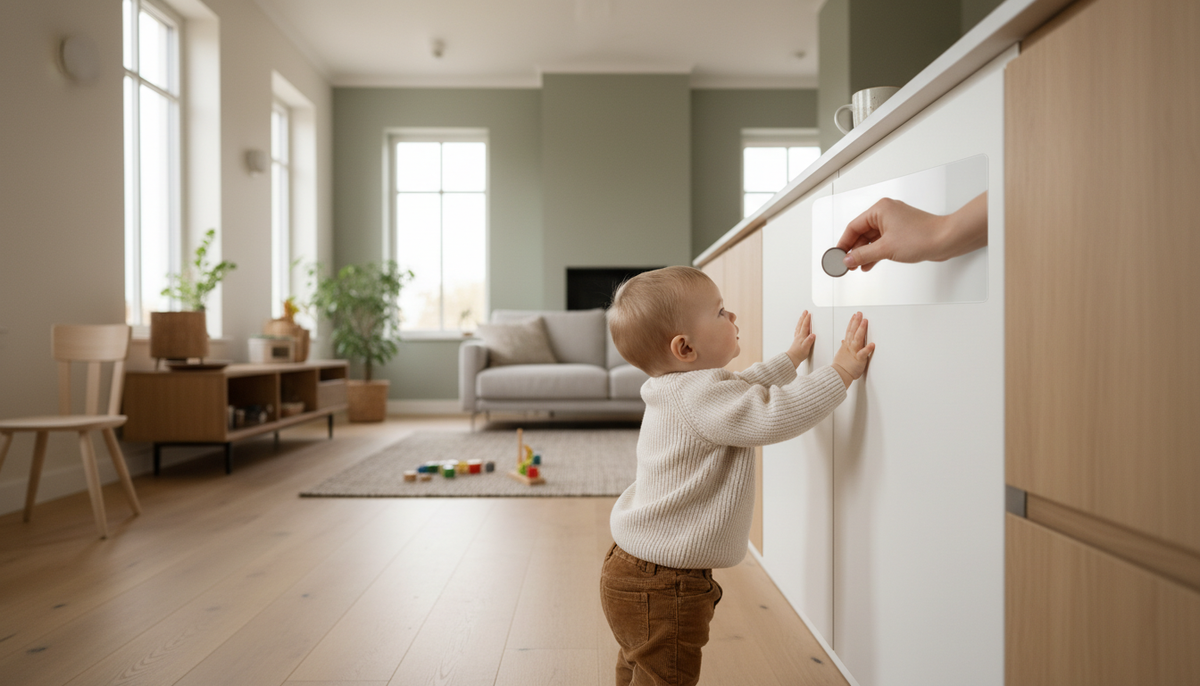
Locks help, but they are one layer. The CPSC says safety latches and locks on cabinets and drawers can help keep children from gaining access to medicines, laundry detergent, household cleaners, matches or cigarette lighters, and knives and other sharp objects. Even products with child-resistant packaging should be locked away and kept out of reach.
The AAP says latches that lock when you close a cabinet door can help. But there is always a chance a device will malfunction or a child will defeat it. The safest place to store poisonous products is somewhere a child can’t see or reach. The CPSC adds that no device is fully childproof, and determined toddlers have been known to overcome or disable them.
Baby Proof Me’s Complete Care Safety Kit holds 12 magnetic cabinet locks with 3 keys, 6 adhesive safety strap locks, 24 outlet plugs and 12 clear corner protectors. Its product page says the magnetic locks help keep your child away from cabinets and drawers containing chemicals, knives or medications. The magnetic lock and strap lock pages say that, for best results, you should allow 24 hours for the adhesive to fully bond, so fit them a day before you rely on them. The kit’s own warning says it is not a substitute for adult supervision.
Keep the keys out of children’s reach, and if one is swallowed, call 911 or Poison Help at 1-800-222-1222.
In the bathroom, the CPSC says to give constant supervision and stay within reach when your baby is bathing, because children can drown in moments. It also says the water heater can be set to 120°F (49°C) or lower to guard against burns. Anti-scald devices for faucets and shower heads are another option.

Living Areas: Outlets, Cords, Furniture and Edges
A baby-proofing checklist for every room includes the living areas, which hold outlets, cords, tall furniture and sharp corners.
The CPSC says outlet covers and outlet plates can help protect children from electrical shock and possible electrocution. Outlet protectors should not be easy for children to remove. They should also be large enough that children cannot choke on them. When you replace receptacles, the CPSC says to use a tamper-resistant type.
Window covering cords need attention too. The CPSC says to use cordless window coverings in homes with young children, because children can wrap the cords around their neck. Where corded coverings can’t be replaced yet, make the pull cords as short as possible to eliminate dangling cords.
Furniture, TVs and ranges can tip over and crush young children. The CPSC says to anchor them to the floor or attach them to a wall. Install freestanding ranges and stoves with anti-tip brackets.
For sharp edges on furniture and fireplaces, the CPSC says to look for corner and edge bumpers that stay securely on.
Stairs, Doors and Windows: Gates, Knob Covers and Guards
The CPSC gives clear advice for stairs. Use safety gates that meet current child safety standards. Use only gates that screw to the wall at the top of stairs, and never use a pet gate as a child safety gate. Replace older gates that have “V” shapes large enough to entrap a child’s head and neck.
Door knob covers and door locks can help keep children away from places with hazards, the CPSC says. Be sure a door knob cover is sturdy and allows a door to be opened quickly by an adult in an emergency.
The CPSC says window screens are not effective for keeping children from falling out of windows. Use window guards and safety netting instead, and limit window openings to four inches or less, including the space between window guard bars.
If you have window guards, make sure at least one window in each room can be easily used for escape in a fire.
Whole-Home Alarms and Pool Barriers
On smoke detector placement, the CPSC says to use smoke alarms on every level of your home, inside each bedroom and outside sleeping areas. Check them once a month to make sure they’re working. Change batteries at least once a year, or use sealed 10-year batteries.
The CPSC also says all consumers should install carbon monoxide alarms outside of bedrooms near each sleeping area. That applies even if the home does not have any fuel-burning appliances. Test them regularly and change their batteries at least once a year.
If there is a pool or spa, the CPSC recommends layers of protection. Examples include self-closing, self-latching pool gates, self-closing and self-locking door mechanisms or door alarms, pool alarms and pool covers. Re-establish the barrier after each pool use.
Going Room by Room, Wherever the Visit Goes
Whether a visit covers every room is a question for the caseworker. Ask what this visit will cover. Going room by room keeps the safety basics in place wherever the visit goes.
No list can promise how a visit goes, but a family can control the everyday routine. The CPSC says safety devices must be properly installed and reengaged after use to be effective. Keeping them working is a habit, not a one-day setup. The CPSC adds that most of these devices are easy to find and relatively inexpensive.
A foster care home inspection is a separate situation, so if that is yours, ask the agency involved what it covers.
Here is a CPS home visit checklist built from CPSC and AAP guidance.
CPSC and AAP Home Safety Checklist
Emergency Lines to Keep on Hand
America’s Poison Centers advises having the Poison Help contact information on hand in case of an accidental exposure. Its national Poison Help line, 1-800-222-1222, gives expert advice at no cost, around the clock. If a child may have swallowed or had contact with something poisonous, call Poison Help.
The AAP says to call 911 if the child is unconscious, not breathing, or having convulsions or seizures due to poison contact or ingestion.
Save Poison Help at 1-800-222-1222 in your phone, as America’s Poison Centers suggests.