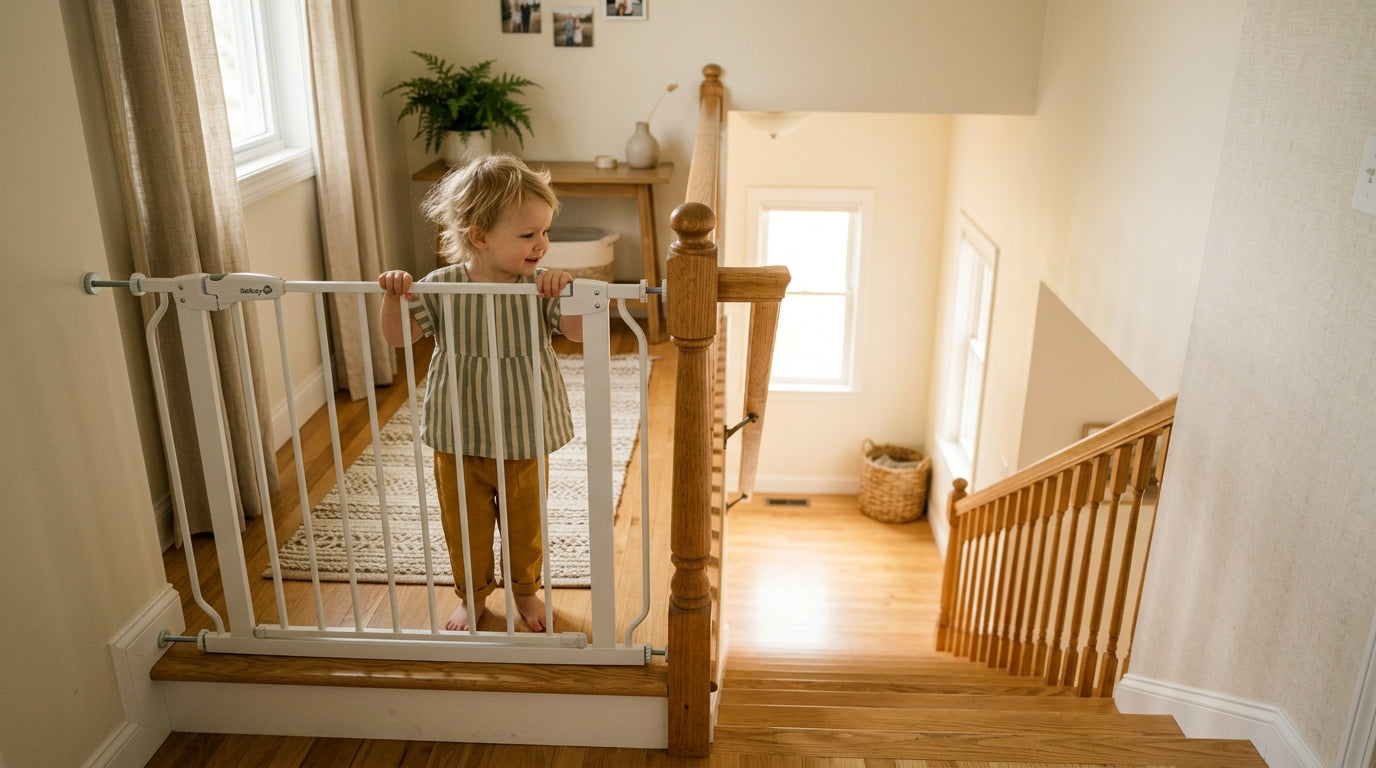
Hardware Mount vs Pressure Mount Baby Gate: The Safety Debate Settled

About 93,000 children under 5 are treated in U.S. emergency rooms each year for stair-related injuries, according to a Nationwide Children’s Hospital analysis of CPSC NEISS data. That’s roughly one child every six minutes. When parents ask me whether the gate type really matters, I think about that number. Then I think about my own stairs.
In my experience, a pressure-mounted gate can fail unexpectedly. My older daughter was 22 months old when she figured out she could rock a pressure-mounted gate back and forth until the tension slipped. She didn’t fall, but she could have. That afternoon I drove to the hardware store, bought a wall-mount kit, and drilled into my door frame. The hole in the drywall healed. The alternative didn’t bear thinking about.
The gate debate isn’t really about preference. It’s about placement, and once you understand that, the rest of the decisions follow naturally.
The Core Difference
Hardware-mounted gates are screwed directly into wall studs or door frame lumber. The brackets are fixed. The gate swings on hinges anchored to those brackets. When a toddler throws their full weight against it, the force transfers into the wall structure, and the gate holds.
Pressure-mounted gates work on tension. Two rubber-tipped spindles press outward against opposing surfaces, and friction is the only thing keeping the gate in place. That friction can weaken. A child who leans, pushes, or hangs on the gate repeatedly is working against that tension every single time. Some gates loosen gradually over weeks. Others shift in a single hard shove.
Both types can be well-made. Both can be ASTM-certified. The difference is physics, and physics doesn’t care about brand reputation.


Where Each Gate Belongs
The CPSC is direct on this point: hardware-mounted gates are the only appropriate choice for top-of-stair installations. A pressure gate at the top of the stairs is a fall hazard. If a child pushes through or destabilizes the barrier, there is nothing below them but the staircase. A properly installed hardware gate cannot be dislodged by a child’s weight or pulling because it is part of the wall.
Pressure gates belong on the same level. Think kitchen doorways, hallway closures, the entry to a home office. If a pressure gate fails in one of those locations, a child gains access to a room. That’s a problem you can manage. A stair fall is a different category of outcome entirely.
In my house, I use a hardware mount at the top of the stairs and a pressure mount at the kitchen entry. The kitchen gate gets bumped, leaned on, and occasionally used as a handhold by my younger daughter when she’s trying to peer over it. I check the tension every week or two. The stair gate I check once a month, mostly out of habit. It has never moved.
| Feature | Hardware Mount | Pressure Mount |
|---|---|---|
| Top-of-stair use | Required | Never safe |
| Same-level use | Yes | Yes |
| Installation | Drill required | No tools needed |
| Wall damage | Holes to patch | No marks |
| Max span | Up to 60 in. | 40–50 in. |
| Tension monitoring | Not needed | Weekly check |
| One-handed open | Most models | Rarely |
| Cost | 20–40% more | Lower upfront |
| Renter-friendly | No | Yes |
| Certification needed | ASTM F1004 | ASTM F1004 |
The Installation Reality
Hardware installation means drilling. You’re going into a door frame or, if the opening is wider, into wall studs. You need a drill, the right bit, and ideally a stud finder. Most hardware gate kits include wall anchors for installations that don’t land on a stud, but anchors into drywall alone are not as strong as a screw into lumber. If you’re unsure about your wall structure, it’s worth having someone experienced take a look before you rely on that gate.
The most common installation error I see is screws that don’t reach the stud, or screws that are too short for the bracket depth. The gate looks solid. It isn’t. Check your screw depth against the bracket spec before you call it done.
Pressure gates, by contrast, install in minutes with no tools. Extend the spindles, press them against the door frame, tighten the tension knob. Done. The risk with pressure gates isn’t installation error in the traditional sense. It’s misuse, specifically placing them somewhere they were never designed to go.
The Tension Problem
Pressure gates fail silently. There’s no alarm, no visual indicator, no obvious sign that the gate has loosened since you last checked it. The rubber feet compress slightly over time. The surfaces they press against may be painted or slightly curved, reducing grip.
Hardware gates don’t have this problem. Once the screws are in and the gate is hung, the only way it moves is if you open it. There’s nothing to re-tighten, no tension to monitor. The visual confirmation of a latched hardware gate is reliable in a way that a pressure gate simply cannot match.
If you use pressure gates, build a check into your routine. Push the gate firmly from both sides once a week. If it shifts or rocks, retighten before you rely on it again.
Cost and Convenience
Hardware gates typically run 20–40 percent more than comparable pressure-mounted models. They also require tools and, in some cases, wall patching when you remove them. For renters, that’s a real consideration. Drilling into an apartment door frame may violate your lease, and even where it doesn’t, you’re responsible for the repair.
Pressure gates are the clear choice for rental properties and temporary installations. They leave no marks, move easily from room to room, and cost less upfront. The trade-off is the maintenance requirement and the absolute restriction against stair use.
On convenience: many hardware gates include a one-handed release mechanism, which matters more than it sounds when you’re carrying a laundry basket or a sleeping toddler. Most pressure gates require two hands to open. In a high-traffic doorway, that adds up.
Width, Fit, and Gaps
Hardware gates accommodate more opening types. Some models span up to 60 inches with extension panels, and they can handle irregular or angled openings that would defeat a pressure gate’s tension system. Pressure gates generally max out at 40–50 inches and require a standard rectangular frame to seat the spindles properly.
Regardless of mount type, fit matters for a specific reason: gaps. Crib slat spacing is regulated at no more than 2 3/8 inches (6 cm) under CPSC standards because that’s the threshold for head entrapment. The same principle applies to gate slat spacing and to any gap between the gate edge and the door frame. Measure your opening carefully. A gate that’s too narrow for the space it’s in leaves a gap at the side that a determined toddler will find.
Certification: What to Look For
ASTM F1004 is the federal safety standard for expansion gates and expandable enclosures, made mandatory under 16 CFR Part 1239 (effective 2021). Look for this certification on the packaging. JPMA certification is an additional layer: the Juvenile Products Manufacturers Association runs an independent testing program, and a JPMA seal means the gate was tested by a third-party lab, not just self-certified by the manufacturer.
Neither certification tells you where to install the gate. That’s your job. A pressure gate with every certification available is still the wrong gate at the top of your stairs.
Making the Decision
Start with your staircase. If you have one, a hardware gate at the top is not optional. Budget for it, plan for the installation, and do it right. Screw depth, stud contact, bracket alignment. Check the gate before you trust it with your child’s safety.
Then look at your same-level openings. Kitchen, playroom, office, wherever you need a boundary. Pressure gates work well here, cost less, and give you flexibility. Just check the tension regularly and never move one to a stair location because it’s convenient.
The "debate" in the title of this piece is mostly settled by physics and by CPSC guidance. Hardware at the top of stairs. Pressure on the same level. Verify ASTM F1004 certification on anything you buy, confirm the gate fits your opening with no problematic gaps, and build a tension-check habit into your week if you’re running pressure gates anywhere in the house. That combination covers the real risk.